Office Address
Rukan Fatmawati Mas Blok 1 Kav.113 Lantai 4, Jakarta Selatan
Phone Number
082122285048
Email Address
sekretariat@akp2i.or.id
Rukan Fatmawati Mas Blok 1 Kav.113 Lantai 4, Jakarta Selatan
082122285048
sekretariat@akp2i.or.id


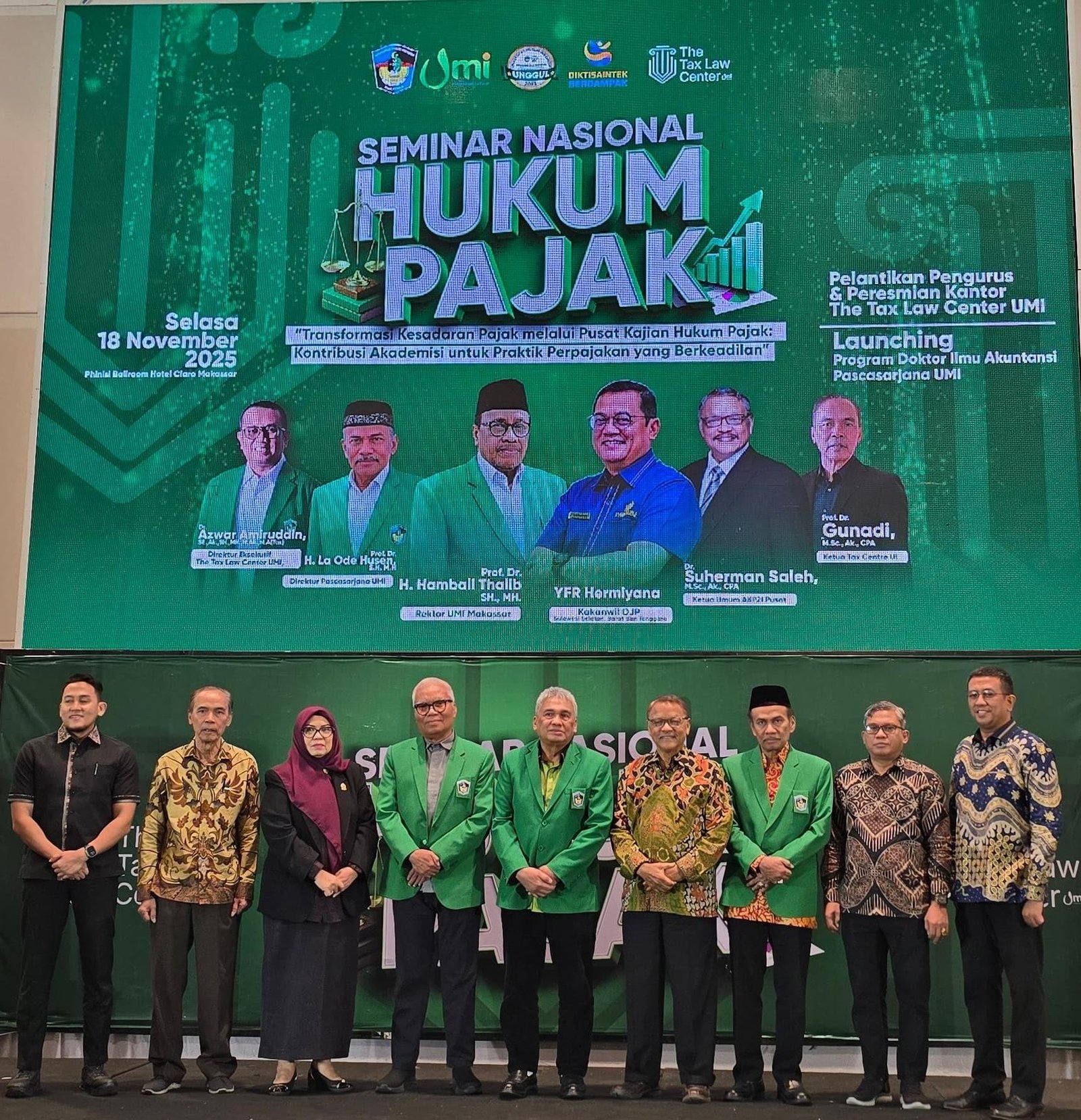
Makassar – It cannot be denied that taxation has become an important aspect of people's lives. Taxes are not only a source of state revenue, but also an instrument for increasing public awareness and participation in national development. However, public awareness of the need to pay taxes is still low, and unfair taxation practices remain a major challenge.
On the other hand, Chairman of the Indonesian Public Tax Consultants Association (AKP2I) Suherman Saleh revealed that the word “tax” is often instinctively interpreted as a “cost” that reduces profitability.
“This is a reasonable but narrow transactional perspective. From the perspective of practitioners who assist the business world, we strive to promote a more strategic understanding: tax awareness is a risk management tool,” he said while giving a speech at the Indonesian Muslim University (UMI) Postgraduate Tax Law National Seminar on Tuesday (11/18).
He added that many taxpayers, especially in the Micro, Small, and Medium Enterprises (MSME) segment, do not conduct risk management analysis. Moreover, they are trapped in passive resistance. This is not planned tax evasion (active resistance), but rather a reluctance to comply caused by ignorance, the perception that the system is too complicated, or distrust of tax allocation. Forms of passive resistance include delaying reporting, messy bookkeeping, or reluctance to move from the informal to the formal sector.
“The focus of practitioners is to encourage taxpayers to move beyond mere ‘formal compliance’ (e.g., only filing tax returns on time to avoid fines) towards ‘material compliance’ (ensuring the correctness and accuracy of tax return content). True tax awareness is the bridge between formal compliance and material compliance,” he added.
The Role of Tax Consultants
Therefore, Suherman also emphasized the important role of tax consultants in bridging taxpayers and tax authorities. This is especially true considering the massive imbalance between the limited number of tax officials, the tens of millions of taxpayers, and the number of professional tax consultants. It is impossible for the state to educate all taxpayers on its own.
“Therefore, professional associations such as AKP2I are strategic partners of the DGT in co-regulation and education. We play an active role in disseminating policies, improving the standards of professionalism of consultants, and becoming an extension of education that reaches taxpayers directly and intensively,” he added.
He continued that the role of consultants is also very much needed to balance technological developments and the modernization of the Directorate General of Taxes (DGT) tax administration. In reality, taxpayers encounter technical difficulties in filling out forms, procedural tax return extension obligations, or handling system errors.
“Tax consultants bridge this gap, ensuring that taxpayers can utilize the modern system correctly, thereby reducing human error that could lead to unnecessary penalties,” he explained.
Research
Suherman hopes that practitioners will turn to academic institutions such as the UMI Center for Tax Law Studies (PKHP) because there is an urgent need to bridge the gap between theory and practice.
“Where the discourse on taxation in Indonesia is too often divided into two camps: academics speak in high-level theoretical and philosophical language, while practitioners ‘bleed’ in the field dealing with chaotic implementation. PKHP UMI has a golden opportunity to become that bridge,” he said.
He also hopes that the research agenda of PKHP UMI will include Ex-Ante and Ex-Post Regulatory Impact Analysis (RIA), Tax Simplification Research, Dispute Resolution Research, and Research on Foundational Justice in the Modern Context.
“The UMI Tax Law Study Center must fill the role of this intellectual ‘referee’. When disputes arise from ambiguous interpretations of rules, the views, studies, or amicus curiae (friend of the court) from PKHP can be a credible and impartial reference for judges in the Tax Court,” said Suherman.
 by Heru Yulianto